
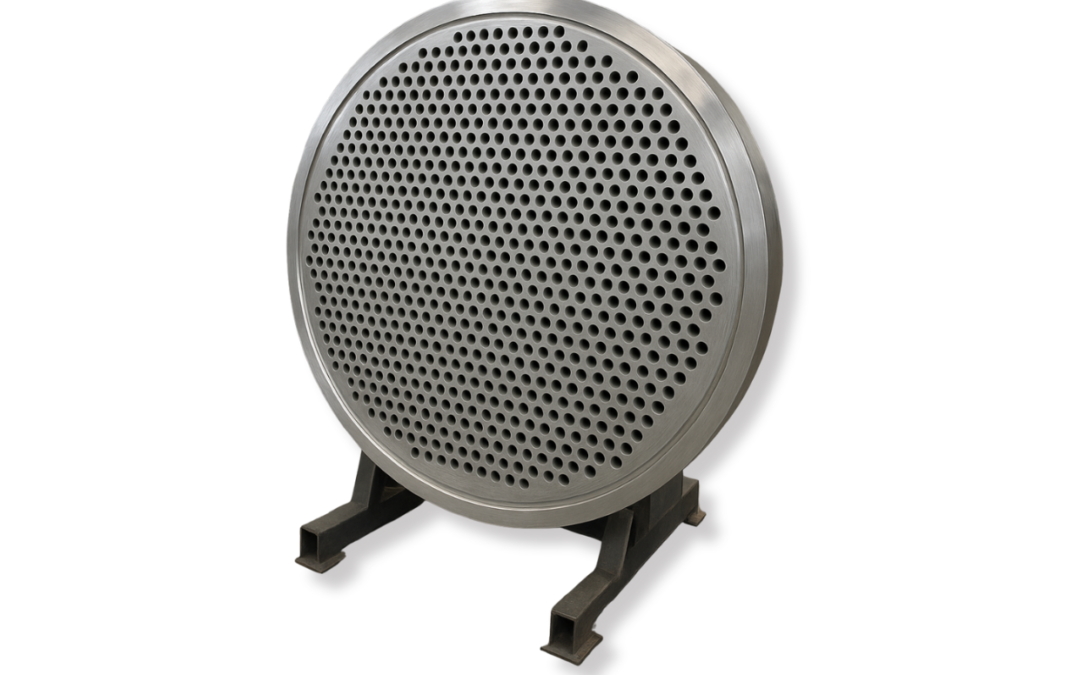
A heat exchanger tube sheet has two jobs: it carries the pressure difference between shell and tube side, and it resists whatever corrosive fluid it touches. That is why tube sheets are made in three ways – solid alloy, explosion clad (a steel base with a corrosion-resistant alloy layer) or weld overlay (alloy deposited on a steel base) – and the right choice depends on thickness, diameter, the process fluid and the tube material.
Three ways to make a tube sheet
| Solid alloy | Explosion clad | Weld overlay | |
|---|---|---|---|
| Construction | One alloy throughout | Steel base + bonded alloy plate | Steel base + welded alloy layers |
| Best for | Thin tube sheets, small diameters, cheap alloys | Medium to very thick tube sheets, any diameter, expensive alloys | Small or complex parts, repairs, nozzles |
| Alloy surface | Full chemistry | Full wrought chemistry, no dilution | Iron dilution in the first layers |
| Flatness / distortion | Good | Flat within 1 mm/m (Shockwave) | Heat input can distort; extra machining |
| Typical thickness range | Up to a few tens of mm | Base 10–500 mm, clad 1–50 mm (Shockwave) | Few mm of overlay per pass |
| Cost driver | Alloy weight | Base steel + thin alloy layer | Welding hours, layers, machining |
For a detailed comparison of the manufacturing routes see explosion clad vs roll bonded vs weld overlay.
Choosing the base material
- Plate: SA516 Gr. 60/70 or P265GH / P355GH for most refinery, chemical and power exchangers.
- Forgings: SA266 or SA350 LF2 (low temperature) for thick tube sheets and integral designs.
- High temperature / hydrogen: Cr-Mo steels such as SA387 Gr. 11 or 22, or the equivalent forgings.
The base is chosen for strength, temperature and weldability to the shell or channel; it does not touch the tube-side fluid when the tube sheet is clad on that side.
Choosing the clad layer
| Clad layer | Typical service |
|---|---|
| Stainless steel 304L / 316L | Refinery and chemical exchangers, feedwater heaters |
| Duplex 2205 / super duplex 2507 | Seawater coolers, chloride-bearing streams |
| Titanium Gr. 1 / Gr. 2 | Seawater condensers, desalination, PTA and chlor-alkali |
| Nickel alloys 625, 825, C-276 | Acid gas, sour service, aggressive chemicals |
| Copper-nickel 90/10 / 70/30 | Seawater-cooled condensers and coolers |
The clad layer usually matches the tube material, so that the tubes can be welded to it – see tube-to-tubesheet welding on clad tube sheets. All combinations we make are on the material combinations page.
Design points to settle early
- Thickness: the tube sheet thickness comes from the pressure design (TEMA and ASME Section VIII or EN 13445), done by the exchanger designer.
- Clad thickness: corrosion allowance plus facing, gasket grooves and the depth of the tube-to-tubesheet weld. A few millimetres is common; thicker layers are used for strength welds and machined faces.
- Which faces are clad: one side (tube side) or both sides when both fluids are corrosive.
- Shape: round discs or rectangles, with or without an extension for bolting or welding to the shell.
- Testing: ultrasonic bond class (see ASTM A578 ultrasonic testing) and, if the exchanger will be heat-treated, bond tests after a simulated cycle.
When is clad the better choice?
As a rule of thumb, the thicker and larger the tube sheet and the more expensive the alloy, the more a clad tube sheet saves over solid alloy: the alloy is only a thin layer, and the steel carries the load. Explosion cladding also suits replacement tube sheets for shutdowns, because it does not depend on mill rolling schedules. Weld overlay remains a good option for small parts, odd shapes and local repairs.
Shockwave supplies explosion clad tube sheets with base thicknesses of 10–500 mm, clad layers of 1–50 mm and single pieces up to 50 tonnes, delivered flat within 1 mm/m and 100% ultrasonically tested. More on our tube sheet cladding page, or send your drawing through our contact page.
Frequently asked questions
What materials are tube sheets made of?
Carbon or low-alloy steel (SA516, P265GH/P355GH, SA266 or SA350 forgings, Cr-Mo steels) for the load-carrying base, and a corrosion-resistant alloy on the fluid side: stainless steel, duplex, titanium, nickel alloys or copper-nickel – either as solid alloy, explosion clad or weld overlay.
What is the difference between a clad and a solid tube sheet?
A solid tube sheet is one alloy throughout. A clad tube sheet has a steel base that carries the pressure and a thin, bonded alloy layer that resists corrosion, which saves alloy and cost on thick tube sheets.
Is weld overlay or explosion cladding better for tube sheets?
Explosion cladding gives an undiluted, flat, uniform alloy layer of any thickness on large tube sheets. Weld overlay suits small or complex parts and repairs, but adds heat input, iron dilution and distortion.
How thick should the clad layer of a tube sheet be?
Enough for the corrosion allowance plus facing, gasket grooves and the tube-to-tubesheet weld. A few millimetres is common; Shockwave supplies clad layers from 1 to 50 mm.
Which tube sheet material for seawater?
Titanium, duplex or super duplex, or copper-nickel are the usual clad layers for seawater-cooled exchangers and condensers, normally matched to the tube material.
Written by Joeri Hofstede, CEO of Shockwave Metalworking Technologies — vacuum explosion welding specialists since 1985.