
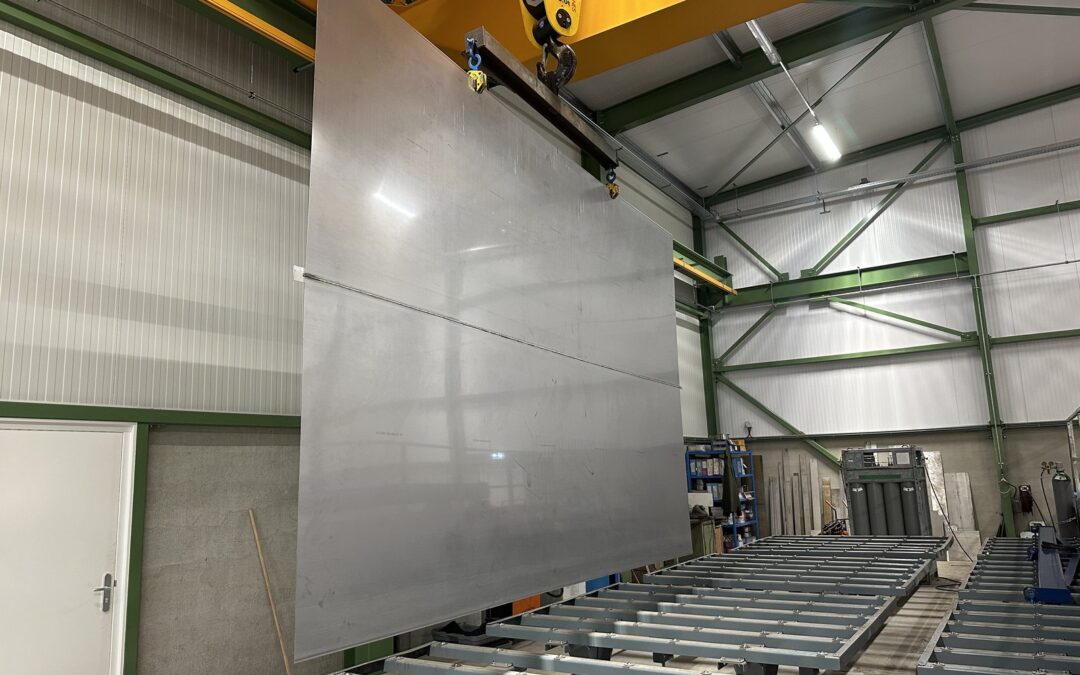
ASME SA-265 (identical to ASTM A265) is the specification for nickel and nickel-base alloy clad steel plate: a carbon or low-alloy steel base with a layer of nickel or a nickel alloy – such as Alloy 625, 825 or C-276 – integrally and continuously bonded to one or both sides. It is written mainly for pressure vessels, but also covers other structures where the corrosion resistance of the alloy is what matters. If your drawing says “nickel clad plate”, “Inconel clad plate” or “Hastelloy clad plate”, SA-265 is almost always the governing specification.
Cladding alloys covered by SA-265
The cladding must meet the chemistry of the ASTM/ASME product specification for that alloy. The specification lists:
| Cladding specification | Typical alloys (common names) | Typical service |
|---|---|---|
| B162 | Nickel 200 / 201 | Caustic soda, alkalis |
| B127 | Alloy 400 (Ni-Cu) | Hydrofluoric acid, seawater |
| B168 | Alloy 600, 690 | High-temperature, chloride stress-corrosion resistance |
| B409 | Alloy 800 / 800H | High-temperature service |
| B424 | Alloy 825 | Sulphuric and phosphoric acid, sour service |
| B443 | Alloy 625 | Sour gas, seawater, chloride and acid service |
| B575 | Alloy C-276, C-22, 59, C-4 | Highly corrosive chemical duty, flue-gas desulphurisation |
| B333 | Alloy B-2 / B-3 | Hydrochloric acid |
| B463, B582, B625 | Alloy 20, G-3, 904L / 31 / 926 types | Sulphuric acid, mixed acids |
Other nickel-base alloys can be used when the purchaser and manufacturer agree. Shockwave clads nickel 200/201, Alloy 400, 625, 825, C-276 and C-22, among others – see all clad plate material combinations.
Base steel
The base can be any carbon or low-alloy steel to an ASTM pressure-vessel or structural specification – typically SA516 Gr. 60/70, SA387 Cr-Mo grades or SA266 / SA350 forgings for tube sheets, or European P265GH / P355 grades. Tensile tests are made on the base steel, which must meet its own specification.
Bond strength
- Shear test (when the purchaser requires it): minimum 20,000 psi (140 MPa) between cladding and base, for cladding of 1.9 mm (0.075 in) and thicker.
- Alternative bond test: three 180° bend tests, agreed between purchaser and manufacturer.
- Tests are made on each plate as heat-treated, and after simulated post-weld heat treatment (SPWHT) when that supplementary requirement is ordered.
Bond quality and ultrasonic classes
The cladding must be integrally and continuously bonded. Plates 10 mm (3/8 in) and thicker are ultrasonically inspected to ASTM A578; thinner plates are inspected visually unless UT is ordered. The purchaser chooses a quality class:
| Class | Largest single unbonded area | Total unbonded area |
|---|---|---|
| Class 1 | 25 mm (1 in) longest dimension | ≤ 1% of clad surface |
| Class 3 | 75 mm (3 in) longest dimension | ≤ 3% of clad surface |
| Class 5 | 58 cm² (9 in²) | ≤ 5% of clad surface |
If no class is stated on the order, the manufacturer may supply Class 5. Full 100% scanning is a supplementary requirement (S12). At Shockwave every production plate gets a 100% automated phased-array scan of the full bond area regardless of the class ordered.
Repairs, welding and certification
Cladding defects may be repaired by welding with ASME Section IX qualified procedures and welders, with liquid-penetrant examination before and after the repair; the purchaser can require prior approval. The certificate reports the chemistry of base and cladding, the mechanical and bond test results and any repairs.
Why explosion cladding for nickel alloys
Explosion welding bonds the nickel alloy plate in the solid state, so the cladding keeps its full wrought chemistry – there is no iron dilution as with weld overlay – and the base steel keeps its properties. It works for thick bases, forgings and tube sheets, and for small quantities that a roll-bonding mill would not take. Shockwave does the bonding inside vacuum chambers, which minimises oxidation at the interface. Clad layers from 1 to 50 mm, plates up to 60 m² and 50 metric tonnes.
Need a quote? Send the alloy, base grade, thicknesses, plate size and the UT class through our contact page. Related: stainless steel clad plate (SA-264) and titanium clad plate (SB-898).
Frequently asked questions
What is ASME SA-265?
The specification for nickel and nickel-base alloy clad steel plate: a carbon or low-alloy steel base with nickel or a nickel alloy bonded to one or both sides, mainly for pressure vessels. It is identical to ASTM A265.
Which alloys can be clad under SA-265?
Nickel 200/201, Alloy 400, 600, 800, 825, 625, C-276, C-22, B-2 and other nickel-base alloys covered by ASTM B127, B162, B168, B333, B409, B424, B443, B463, B575, B582 and B625.
What shear strength does SA-265 require?
When the purchaser requires a shear test, at least 20,000 psi (140 MPa) between cladding and base. Three bend tests may be agreed as an alternative.
What are the ultrasonic classes in SA-265?
Class 1 (single unbonded area ≤ 25 mm, total ≤ 1%), Class 3 (≤ 75 mm, total ≤ 3%) and Class 5 (≤ 58 cm², total ≤ 5%). Without a class on the order, Class 5 applies.
Is Inconel clad plate covered by SA-265?
Yes. Alloy 625 and 600-type alloys (often sold under the Inconel® trade name) are nickel-base alloys covered by SA-265.
Written by Joeri Hofstede, CEO of Shockwave Metalworking Technologies — vacuum explosion welding specialists since 1985.