
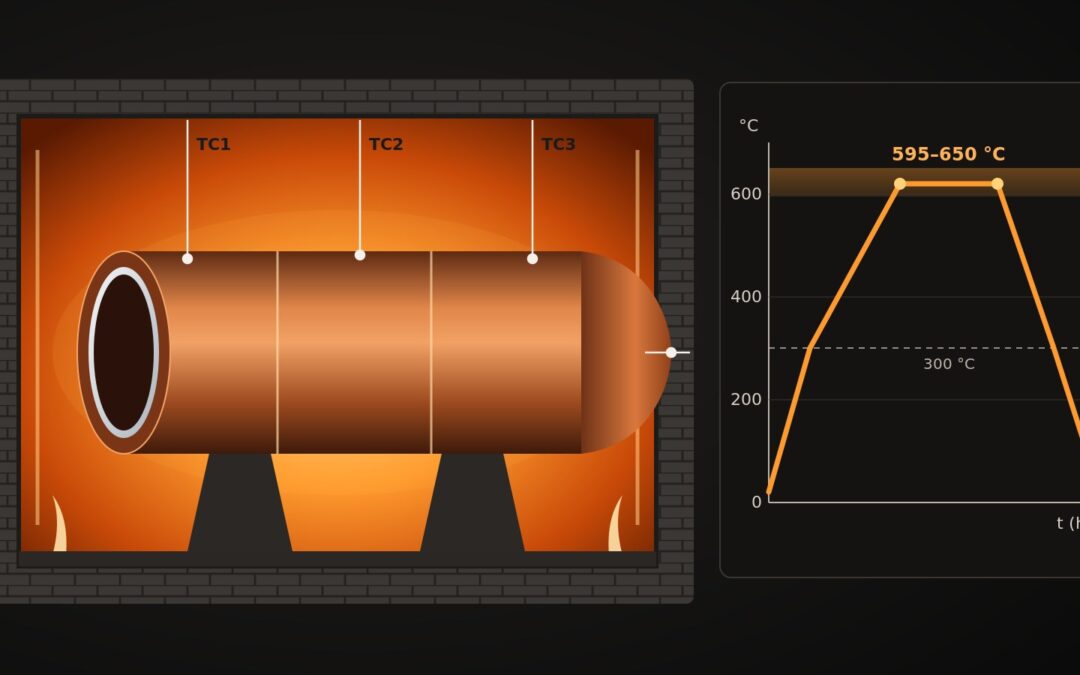
Post-weld heat treatment (PWHT) is the controlled heating of a welded vessel or part, typically to around 600–650 °C for carbon steel, to relieve welding stresses and temper hard zones. When the vessel is made of clad plate, the cycle that suits the steel base also has to suit the cladding alloy and the bond between them, so the PWHT should be known before the clad plate is ordered.
Why clad vessels are heat-treated
Codes such as ASME Section VIII and EN 13445 require PWHT for many carbon and low-alloy steel vessels, depending on the material group and the thickness at the welds, and service conditions such as sour or caustic duty often make it mandatory. The steel base of a clad plate is treated like any other pressure-vessel steel; the designer and fabricator decide whether PWHT is needed and set the cycle. The heat treatment is carried out by the fabricator on the finished vessel or part.
What PWHT does to the cladding
| Clad layer | What to watch | Common practice |
|---|---|---|
| Austenitic stainless (304L, 316L, 321, 347) | Sensitisation (chromium carbides) in the 450–850 °C range | Use low-carbon L or stabilised grades; agree the cycle |
| Duplex and super duplex | Sigma and other phases form in the PWHT temperature range and reduce toughness and corrosion resistance | Avoid PWHT where possible or keep it short; qualify the cycle |
| Nickel alloys (625, 825, C-276) | Usually tolerate typical carbon-steel PWHT; check corrosion requirements for the alloy | Agree the cycle with the alloy supplier data |
| Titanium, zirconium | Reaction with the steel at the interface at high temperature; embrittlement by gas pick-up | Limit temperature and time; qualify on test coupons |
| Copper-nickel | Generally tolerant; check with the specification | Agree the cycle |
What PWHT does to the bond
An explosion bond withstands the PWHT cycles normally used for carbon-steel vessels. Heat treatment softens the work-hardened zone at the interface and can cause some diffusion across it. For combinations that form brittle compounds at high temperature, titanium, zirconium or aluminium on steel, the temperature and time must be limited. The way to prove the bond is fit for the actual cycle is to test it after the same cycle.
Simulated PWHT of test coupons
The clad plate specifications let the purchaser order mechanical and bond tests after a simulated post-weld heat treatment (SPWHT): test coupons cut from the clad plate are given the same temperature, holding time and heating and cooling rates as the vessel will see, and are then tested in shear, tension and bending. ASME SA-265, for example, lists SPWHT of mechanical test coupons as a supplementary requirement; SA-264 and SB-898 have similar options.
What to specify on the order
- Whether the vessel or part will be post-weld heat-treated, and how often (including repairs).
- The cycle: temperature, holding time, heating and cooling rates.
- Which tests must be done after simulated PWHT: bond shear, tensile, bend, impact.
- Any corrosion tests required on the cladding after the cycle.
With this information the clad plate is tested in the condition it will actually be used in. Shockwave does not carry out heat treatment; the plates are supplied in the as-clad condition for the fabricator’s PWHT. Related reading: pressure vessel cladding, how to weld clad plates, stainless steel clad plate and titanium clad plate. Questions about a specific combination? Use our contact page.
Frequently asked questions
Can clad plates be post-weld heat-treated?
Yes. Clad vessels are routinely heat-treated after welding. The cycle must suit the steel base, the cladding alloy and the bond, so it should be known when the clad plate is ordered.
What is simulated PWHT (SPWHT)?
Test coupons from the clad plate are given the same heat-treatment cycle as the vessel and then tested for bond shear, tensile and bend strength, proving the plate’s properties after the real cycle.
Does PWHT affect stainless steel cladding?
Austenitic stainless can sensitise during PWHT, which reduces corrosion resistance. Low-carbon L grades or stabilised grades such as 321 and 347 are used to avoid this.
Can duplex clad plate be heat-treated?
Duplex and super duplex can form sigma and other harmful phases in the PWHT temperature range, so PWHT is avoided or kept short and qualified for duplex-clad equipment.
Is the PWHT temperature limited for titanium clad plate?
Yes. Titanium and steel react at high temperature, so the temperature and time of PWHT are limited and the bond is tested after a simulated cycle.
Written by Joeri Hofstede, CEO of Shockwave Metalworking Technologies, vacuum explosion welding specialists since 1985.