
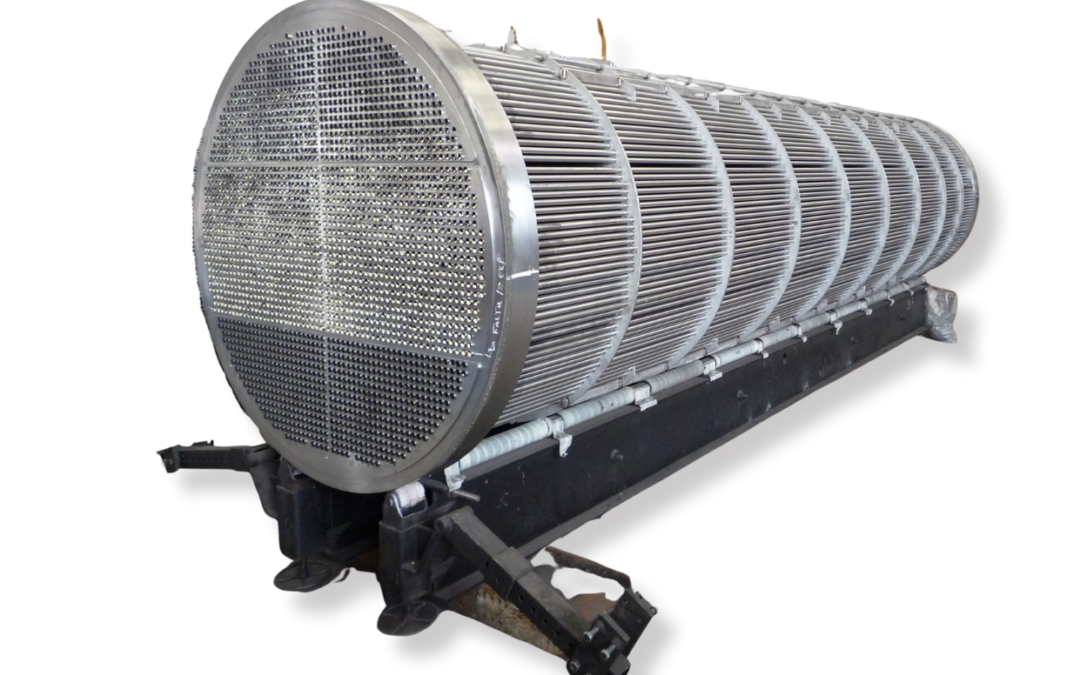
Tube-to-tubesheet welding joins each heat-exchanger tube to the tube sheet with a seal or strength weld, usually after or combined with tube expansion. On a clad tube sheet the tubes are welded to the corrosion-resistant clad layer, not to the steel base – so the clad material, its thickness and the quality of the bond under every tube hole decide whether the joint will stay leak-tight.
Seal welds and strength welds
| Seal weld | Strength weld | |
|---|---|---|
| Purpose | Leak tightness; the load is carried by the expanded joint | Carries the tube load (and gives leak tightness) |
| Typical design | Small fillet or fusion of the tube end | Larger fillet or groove weld sized for the tube load |
| Expansion | Required for strength | Optional or light expansion to close the crevice |
| Typical use | Moderate pressure and temperature | High pressure or temperature, lethal or toxic service, cyclic duty |
The joint type, weld size and qualification follow the exchanger code – TEMA and ASME Section VIII (with tube-to-tubesheet procedures qualified to ASME Section IX, including mock-up tests) or EN 13445 – and are set by the exchanger designer.
Welding processes
- Orbital GTAW (TIG) is the standard: automatic, repeatable, with or without filler wire. Autogenous welds suit thin-walled tubes and seal welds; filler wire is added for strength welds and to control the chemistry.
- Manual GTAW for repairs, plugging and small exchangers.
- Filler metal matches the clad layer and the tube: for example 308L/316L for austenitic stainless, 2209 for duplex, ERNiCrMo-3 for Alloy 625, and titanium filler for titanium – titanium tubes are always welded to a titanium layer, never to steel.
Why the clad layer matters
- Clad thickness: the weld and its heat-affected zone must stay in the clad layer, with no dilution from the carbon-steel base. Allow for the weld depth plus facing, gasket grooves and any machining. A few millimetres is often enough for seal welds; strength welds and machined faces need more. Shockwave supplies clad layers from 1 to 50 mm.
- Full alloy chemistry: an explosion clad layer is a wrought plate at its specified chemistry right down to the interface. A weld-overlay face can carry iron dilution in its lower layers, which matters if the tube weld or facing reaches them.
- Bond under every hole: drilling and expansion load the interface around each hole. The bond must be continuous – Shockwave scans 100% of the bond area by automated phased-array ultrasonic testing before delivery.
- Flatness: a flat tube sheet keeps drilling accurate and tube ends at the same height for orbital welding heads. Shockwave delivers tube sheets flat within 1 mm/m.
Typical sequence
- Drill and ream the tube holes; machine any grooves.
- Clean tube ends and holes; insert the tubes and set the projection.
- Tack or light-expand the tubes to position them.
- Weld (orbital GTAW), then expand to the final value – or expand first and weld afterwards, as qualified in the procedure.
- Inspect: visual, liquid penetrant on the welds, and a leak test (hydrostatic, air/bubble or helium) as specified.
Material combinations for welded tube sheets
| Clad layer | Tubes | Typical service |
|---|---|---|
| 304L / 316L stainless | Stainless steel | Refinery and chemical exchangers, feedwater heaters |
| Duplex 2205 / super duplex 2507 | Duplex | Seawater coolers, chloride-bearing process streams |
| Titanium Gr. 1 / Gr. 2 | Titanium | Seawater condensers, desalination, PTA and chlor-alkali |
| Nickel alloys 625, 825, C-276 | Nickel alloy | Acid gas, sour service, aggressive chemicals |
| Copper-nickel 90/10 / 70/30 | Copper-nickel | Seawater-cooled condensers and coolers |
More on design and sizes on our tube sheet cladding page; for clad shells and heads see pressure vessel cladding, and for butt welds in clad plate see how to weld clad plates. For a quote, send the base and clad grades, thicknesses, diameter and quantity through our contact page.
Frequently asked questions
What is tube-to-tubesheet welding?
Welding each heat-exchanger tube to the tube sheet with a seal weld or a strength weld, usually combined with tube expansion, to make the joint leak-tight and – for strength welds – load-bearing.
Which welding process is used for tube-to-tubesheet welds?
Mostly orbital GTAW (TIG), with or without filler wire. Manual GTAW is used for repairs and small exchangers.
How thick should the clad layer be for tube welding?
Thick enough to contain the weld and its heat-affected zone plus any facing, grooves and machining, so the weld never reaches the steel base. Shockwave supplies clad layers from 1 to 50 mm.
Can titanium tubes be welded to a titanium-clad tube sheet?
Yes. Titanium tubes are welded to the titanium clad layer with titanium filler under full inert-gas shielding; titanium is never welded directly to the steel base.
What is the difference between a seal weld and a strength weld?
A seal weld only provides leak tightness and relies on tube expansion for strength. A strength weld is sized to carry the tube load.
Written by Joeri Hofstede, CEO of Shockwave Metalworking Technologies — vacuum explosion welding specialists since 1985.