
Pressure Vessel Cladding: Explosion Clad Plates for Vessels, Columns and Reactors
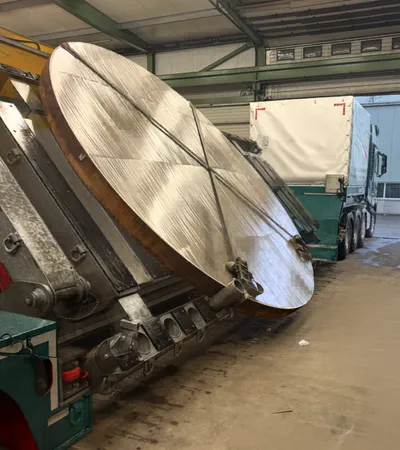
Pressure vessel cladding gives a vessel a corrosion-resistant inner surface while a carbon or low-alloy steel shell carries the pressure. Shockwave supplies vacuum explosion clad plates and round blanks for pressure vessels, columns, reactors, separators and drums — up to 60 m² and 50 tonnes in a single piece, with 100% ultrasonic testing of the bond.
Applications
- Pressure vessels, separators and drums for oil & gas
- Reactors and columns for chemical and petrochemical plants
- Heat exchanger shells, channels and tube sheet cladding
- MSF and MED evaporator shells for desalination
- Round blanks for dished and flat heads
Typical material combinations
- Base: SA516 Gr. 60/70, P265GH / P355GH, HIC-resistant and Cr-Mo steels (SA387); forgings SA266 / SA350
- Clad: stainless steels 304L, 316L, 321; duplex 2205 and super duplex 2507; nickel alloys 400, 625, 825, C-276, C-22; titanium and zirconium
See all clad plate material combinations.
Why explosion clad plate for pressure vessels
Compared with solid alloy plate, an explosion clad plate uses only a few millimetres of expensive alloy where the process fluid touches the vessel, while the steel carries the pressure. Compared with weld overlay, the clad layer is a solid wrought plate at its full specified chemistry — no dilution, no heat-affected zone in the base metal and no distortion — and large single plates reduce the number of shell seams.
- 100% metallurgical bond, no gaps for corrosion to start
- Clad layer 1–50 mm, sized for corrosion allowance and forming
- Plates up to 60 m² and 50 tonnes reduce welding on site and in the shop
- Clad plates can be rolled into shells and pressed into heads by the vessel fabricator; tell us the forming and PWHT route so we can test the bond after a simulated cycle
Testing and standards
| Inspection | Scope |
|---|---|
| Ultrasonic testing | 100% automated UT of the full bond area |
| Mechanical tests | Bond shear, through-thickness tensile, face, side and 180° bend tests on a traced coupon from each plate |
| Material checks | PMI (XRF) and hardness traverse |
| Specifications | Tested per ASME SA-263 / SA-264 / SA-265 or EN 13445-2, also after simulated PWHT |
| Inspection | Third-party and class inspections welcome; audited by Aramco, Shell and Repsol |
Frequently Asked Questions
What is pressure vessel cladding?
Pressure vessel cladding is a corrosion-resistant alloy layer bonded to the inside of a carbon or low-alloy steel vessel. With explosion clad plate the alloy layer is metallurgically bonded to the steel before the vessel is fabricated, so the steel carries the pressure and the alloy resists the process fluid.
Explosion clad plate or weld overlay for a pressure vessel?
For shells, heads and large surfaces, explosion clad plate gives a uniform, undiluted alloy layer and a flat plate with low distortion, usually at lower cost and shorter lead time than overlay. Weld overlay remains practical for nozzles, flanges and repairs.
Which codes and specifications apply?
Clad plates are tested per ASME SA-263 (stainless chromium), SA-264 (stainless chromium-nickel) and SA-265 (nickel alloys), or EN 13445-2 for European pressure equipment. The vessel itself is designed by the fabricator to ASME Section VIII or EN 13445.
Can clad plates be formed into shells and heads?
Yes. Clad plates can be rolled into shells and pressed into heads by the vessel fabricator. Share the forming and post-weld heat treatment route with us, so the bond can be tested after a simulated PWHT cycle.
How large can a clad plate be?
Shockwave produces clad plates up to 60 m² and 50 tonnes in one piece, with clad layers from 1 to 50 mm.